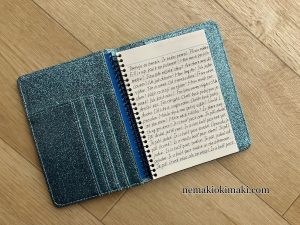
There was a time when I couldn’t save any money at all, and my understanding of English was so vague that I couldn’t even clearly distinguish between so and because. I would lash out purely on emotion, collide with others over and over, and things weren’t going well in either my work or private life. From there, as if the scenery had flipped, my life began to shift gracefully for the better—and without question, behind that change was the simple yet profound act of “writing.”
The countless words I had poured out with all my might became a history that belonged only to me, forming a solid foundation that now supports who I am. Things become refined into the form that suits us only through repeated trial and error. This time, I’ll share the process through which I rewove my life with my own hands, along with three polished methods for writing.
1. Apple’s Notes App
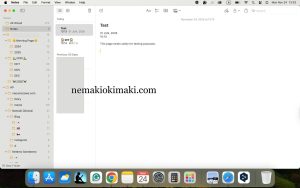
A minimalistic notes app developed by Apple, pre-installed on iPhone and Mac. But this simplicity is truly exceptional. The beautifully stripped-down UI is intuitive yet carries a certain dignified stillness.
In my case, I consolidate “almost everything” in this app, except for budgeting and studying, which I’ll mention later. From shopping lists to bullet journals, morning pages, blog draft writing, and backups, the entire flow is completed within this single app.
And what delights me most is the sync with the iPhone. When an idea strikes while I’m out, I can jot it down instantly, then expand on it after returning home and elevate it into an output; it supports this spontaneous cycle. Year by year, I feel as though the scattered pieces of written information are quietly converging inside this app.
2. Google Spreadsheet
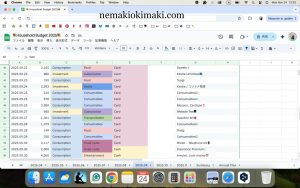
I use this as my household budget book. When dealing with numbers, the power of spreadsheet software is undeniably great. My budgeting journey began with manually pasting receipts onto paper, then moved through handwritten notebooks, specialized apps, and various other services before finally settling into this “cloud × customizability” style.
I’d love to share more about my long journey with budgeting another time.
3. Paper Notebook + Favorite Pen
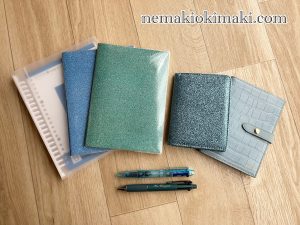
The final one is the only analog method. The notebook and pen I introduced when showing what’s inside my bag are mainly my partners for studying.
Especially after I began studying foreign languages, I naturally developed the physical habit of “first writing down anything I want to remember.” Phrases from textbooks, new vocabulary, and expressions that caught my ear on Netflix. I simply write and write and write, filling the lines of the notebook.
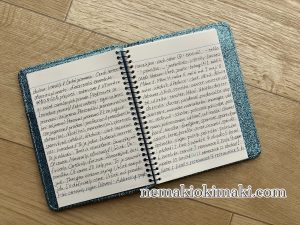
The process is almost like sutra copying. People are surprised when I tell them that I hardly ever look back at the fully filled pages, and that once they reach a certain volume, I cleanly dispose of them—they seem even more shocked. My purpose is solely to “internalize through the act of writing.” So there’s no need to write beautifully or keep the pages. Still, the sight of words densely piling up in the notebook is impressive even to me. That’s why today again, I find myself mindlessly blackening the pages♡
These are the writing methods that continue to spark joy for me as of December 2025. No matter how much the times change, writing is the skill I want to continue polishing sincerely—to organize my thoughts, refine my career, and update my life. I also plan to share deeper dives into each topic later, such as budgeting, morning pages, and language study.
May your writing life become even richer and more colorful from here on♡
Note:
Including part-time jobs, I’ve worked at more than ten companies over my 33-year life. Since I often join companies with the intention of eventually changing jobs, I’ve developed a particular habit over the past few workplaces: while taking notes during OJT or training using Microsoft apps (Word, Excel, PowerPoint), I customize them from the start into a format that could be used by whoever comes after me.
If it’s an unfamiliar industry, it naturally takes time to understand the work. But by explaining your tasks to others in an easy-to-understand way, the structure inside your own head also becomes clearer.
Of course, during employment, I put 100% of my energy into the work itself. But creating a handover file from scratch after deciding to resign is honestly quite tough. That’s why I “raise” my personal notes from the beginning in a state where they can be handed over. At the end, during small pockets of time before leaving, I just tidy them up and change the file name from “personal notes” to “handover file,” and it’s done.
If you’re in an office with a company-issued PC and job changes are within your horizon, this is definitely something worth trying♡