Living in a cluttered “messy room” with no space to step and having zero savings—those were my typical rock-bottom days. The turning point came in 2019, when I was 26 and managed to make my dream of studying abroad come true on my own. And the origin of all that was none other than the “self-reform” I began at 23, when I started dreaming about studying abroad. With no knowledge or know-how at the time, I went to the library and devoured every book about money I could find.

↑ Me at 23, exactly ten years ago. I was always full-throttle with both work and play. But the one thing that never increased was my savings.
During those book-soaked days, I suddenly realized something: there might be a surprisingly deep connection between “saving money” and “decluttering.” After all, every “good saver” featured in magazines lived in an orderly, beautiful home that looked as if even the air was pure. Not a single one lived in a “messy-as-can-be room” like mine back then. It may be obvious, but for me at the time, it was a revelation.
Of course, a messy room is not 100% the reason you can’t save money. But it doesn’t feel unrelated either. So I changed course right there in front of the bookshelf—from “money books” to “storage and decluttering books.” That’s where I discovered Marie Kondo’s bestselling book The Life-Changing Magic of Tidying Up. I read the book version, but there’s also a Netflix documentary and a manga adaptation, so I highly recommend checking them out.
And the very first action I want to recommend to saving beginners is “tidy your room and keep it beautiful.” I’ll introduce my customized, self-adapted version of the KonMari Method in another article… but today, I’ll share two “simple habits you can start right now” that await after tidying—and are deeply connected to saving money.
① Making a Shopping List
The “shopping list” I’m talking about is not the one you make right before going to the supermarket. It’s a “short-term list” of items you buy every week or month. But in a messy room, it’s hard to grasp what and how much you use in a month. That’s why the key is to make this after decluttering.
Later, when I started keeping a household budget, I realized that I used to be a chronic “small-purchase spender.” Now, I have “no-money-days” (days I spend $0) that make up even half the month, but back then, I was spending the equivalent of several dollars every single day.
Even worse, whenever I went to the supermarket, my hand would wander toward “this and that.” So by making a list in advance, you can maximize how much you buy in one trip and minimize the number of shopping trips.
You can freely customize the categories according to your lifestyle!
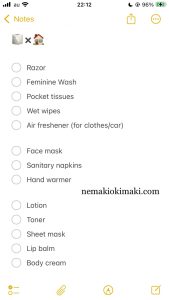
↑ My actual shopping list. At the start of each month, I copy and paste it and pick what I need.
By the way, now that my system is optimized, the items I list are “food” and “daily necessities.” I shop for food once a week and for daily necessities once a month. Since I bulk-buy daily necessities on Amazon, my time at home is even more comfortable (and I become even more of a homebody♡).
Of course, unexpected purchases do happen. In those cases, I either think carefully before adding them to the list or treat them as a one-time irregular item. This list should be reviewed regularly and updated to fit your lifestyle.
② Wallet Diet
If you’ve read this far, you may already notice it—decluttering affects not just your home but everything around you. In other words, your wallet, your bag, and everything within a 5-meter radius of you should ideally stay tidy.
Places that stay tidy don’t let unnecessary things in, and your focus naturally increases. If tidying your room or bag feels too overwhelming… then start with “slimming down your wallet.”
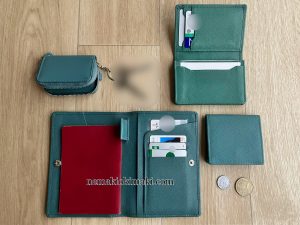
↑ The selected items I introduced in “What’s in My Wallet.”
The two key points are: “reduce your cards” and “check the contents every day.”
Here’s the actual “card-reduction process” I followed:
① Digitize point cards and discard all physical ones
I kept only those from supermarkets and drugstores that I frequently visit. I don’t even install apps for others.
② Digitize hospital ID cards and medication notebooks whenever possible
I said goodbye to the clinics in the regions where I used to live. If something can be digitized, I switch actively.
③ Consolidate credit cards into two (main & backup)
Credit cards that increased due to campaigns were sorted out after paying off balances. It’s been five years with this minimal setup—totally stress-free!
④ Consolidate bank accounts/cash cards into two (salary deposit & savings)
Having more accounts doesn’t mean your money increases… a sad truth. That’s why simpler is better.
With only the “absolute essentials” remaining in my wallet, I take care of it every day by checking its contents. Nowadays, I basically don’t take receipts, and if I do, I throw them away immediately. When I first started budgeting, I kept them, but now my credit card history is linked automatically, so I just copy it into my spreadsheet budget. Receipts tend to clutter both wallets and bags, so letting them go quickly is the correct move.

↑ A photo in Prague, Czech Republic, where I studied abroad. My minimalism accelerated while abroad, bringing me much closer to my current style.
These are the two simple, easy-to-start habits I wish I could tell my former “saving beginner” self.
I’ll keep sharing relaxed, easy-to-adopt life hacks, so please look forward to the next article!